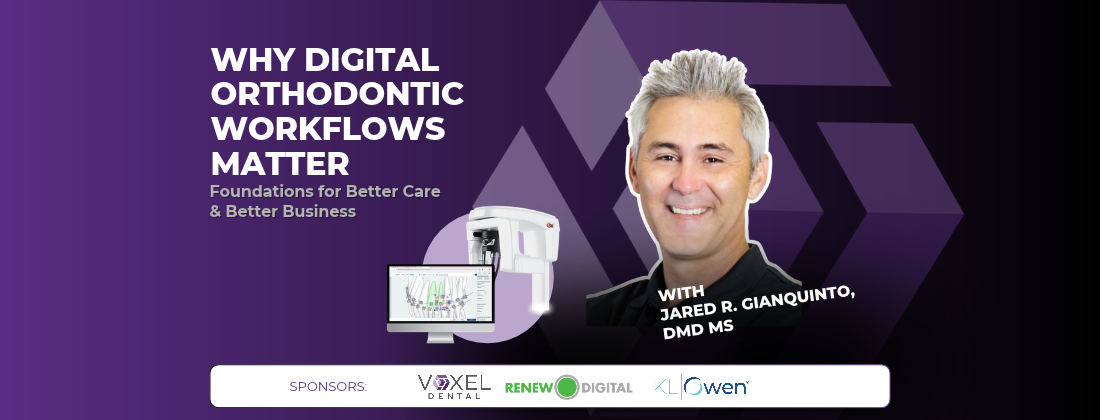
How can orthodontists see fewer patients per day, reduce chairside demands, and still grow their practices? According to Dr. Jared Gianquinto, the answer isn't necessarily hiring more associates, adding chairs, or extending office hours. It may be rethinking the way orthodontic treatment is planned and delivered.
In our recent webinar, Why Digital Orthodontic Workflows Matter, Dr. Gianquinto, a private-practice orthodontist in Bakersfield, California, shared how adopting custom digital orthodontic workflows transformed his practice.
Sponsored by KL Owen custom digital orthodontic solutions, Voxel Dental Solutions digital workflow consultants, and Renew Digital certified pre-owned digital imaging, the presentation explored everything from digital indirect bonding and customized brackets to CBCT imaging, intraoral scanning, team training, and practice efficiency.
Perhaps most importantly, Dr. Gianquinto shared actual treatment cases and practice performance metrics that demonstrated what a more efficient orthodontic workflow can look like.
Ready to watch the full webinar? Follow this link for the online recording and earn 1 CE: Why Digital Orthodontic Workflows Matter.
The Problem: When the Orthodontist Becomes the Bottleneck
Like many orthodontists, Dr. Gianquinto found himself facing a familiar challenge: a growing practice that demanded more of his time.
Between bonding appointments, bracket repositioning, wire adjustments, finishing procedures, and consultations, much of his daily schedule depended on his personal involvement.
With increasing competition in his market and a desire to spend more time with his family, he began looking for an alternative to the traditional approach of simply seeing more patients.
His solution was to transition toward customized digital orthodontic treatment planning and delivery.
By incorporating digital workflows into his practice, Dr. Gianquinto found opportunities to delegate more procedures to his team, reduce unnecessary appointments, and spend less time making adjustments during treatment.
The goal wasn't to remove the orthodontist from the process. It was to use technology to make the orthodontist's time more valuable.
Digital Indirect Bonding Is Only Part of the Equation
One of the webinar's most interesting discussions focused on the difference between traditional indirect bonding and truly customized digital orthodontic treatment.
Dr. Gianquinto explained that simply moving brackets from direct bonding to digitally planned indirect bonding doesn't necessarily solve the underlying challenges of conventional orthodontic mechanics.
Traditional bracket prescriptions still have limitations related to torque expression, bracket positioning, and wire-slot interactions.
Even with an accurate digital setup, orthodontists may find themselves spending significant time repositioning brackets or making finishing adjustments.
This is where customized orthodontic systems, including KL Owen's KL1 system, offer a different approach.
Rather than relying on a single standard bracket prescription, the KL1 workflow uses digital treatment planning to select from different bracket prescriptions and make precise adjustments to torque and offsets.
Dr. Gianquinto explained how this approach helps him execute his intended treatment plan with fewer adjustments throughout the process.
The takeaway? Digital orthodontics becomes more powerful when treatment planning, appliance customization, and clinical mechanics work together.
Why CBCT Imaging Matters in Digital Orthodontics
Another major theme of the webinar was the role of 3D imaging in treatment planning.
Dr. Gianquinto emphasized that while traditional 2D panoramic and cephalometric imaging remains widely used, it cannot provide the same visualization of root positions, alveolar bone boundaries, and certain anatomical limitations as CBCT.
This becomes particularly important when using customized fixed appliances capable of producing more precise torque expression.
Through several clinical examples, he demonstrated how CBCT imaging helped identify anatomical considerations that could influence treatment decisions.
These included:
- Evaluating buccal bone thickness before expansion.
- Identifying root positions and anatomical limitations.
- Planning treatment around impacted teeth.
- Monitoring tooth movement and making corrections when necessary.
Dr. Gianquinto also discussed radiation exposure, emphasizing the importance of understanding the capabilities and settings of modern CBCT systems.
His practice uses an i-CAT FLX CBCT system purchased through Renew Digital, which he described as a valuable investment in his digital workflow.
While imaging decisions should always be based on individual clinical needs and appropriate radiation protection principles, the presentation illustrated how 3D information can support more informed treatment planning.
Building a Connected Digital Orthodontic Workflow
 Of course, the benefits of digital orthodontics extend beyond imaging and brackets.
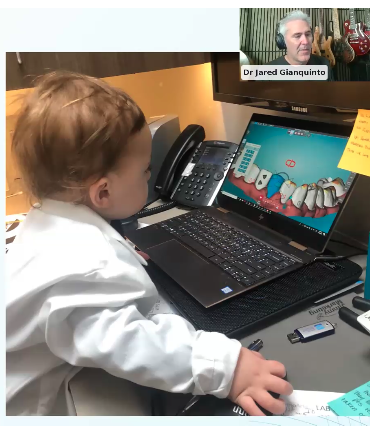
Dr. Gianquinto walked attendees through the workflow his team uses, from the initial patient inquiry through treatment planning, appliance delivery, and monitoring.
His process incorporates digital patient intake, intraoral scanning, CBCT imaging, customized treatment planning, indirect bonding, and remote monitoring.
For intraoral scanning, his practice uses two Alliedstar scanners, which he praised for their speed, reliability, ease of use, and affordability.
These scanners play an important role in collecting digital records that can be incorporated into treatment planning and appliance fabrication.
He also discussed the importance of selecting technology that staff can confidently operate and that offers dependable training and technical support.
After treatment begins, his practice uses remote monitoring to help identify potential concerns, including hygiene issues and appliance breakage, between appointments.
The result is a more connected process in which each technology supports the next step rather than creating additional work for the team.
The Results: Fewer Appointments, More Production
Perhaps the most compelling portion of the webinar came when Dr. Gianquinto shared how his digital transition affected his practice.
His reported practice results included:
| Practice metric | Before | After |
|---|---|---|
| Clinical days per week | 3.5 | 2.5 |
| Patients seen per day | 70–80 | 35–40 |
| Production | Baseline in 2021 | 50% increase |
Dr. Gianquinto also described treatment cases in which the number of active appointments was reduced substantially compared with his previous conventional workflows.
In one example, he reported reducing a case from approximately 13 active visits to seven, representing a 46% reduction.
He emphasized that treatment efficiency doesn't always mean dramatically shortening the total duration of treatment. Some orthodontic movements still require time.
Instead, the benefit often comes from reducing the number of appointments and the amount of doctor time required to achieve the desired result.
For his practice, that has translated into more flexibility, fewer scheduling demands, and additional time outside the office.
These results reflect Dr. Gianquinto's individual experience and aren't guaranteed outcomes for every practice.
What Happens When Digital Orthodontic Treatment Doesn't Go as Planned?
Dr. Gianquinto also addressed an important reality: digital technology doesn't eliminate clinical challenges.
In fact, greater precision can create additional responsibilities.
Customized bracket prescriptions and more complete torque expression require careful treatment planning, particularly when working near anatomical boundaries.
He shared examples in which root positioning required corrections during treatment and explained how he addressed those situations through bracket changes or wire adjustments.
His advice was to understand the limitations of the technology, review treatment setups carefully, and use appropriate imaging to monitor progress.
Digital tools can improve the execution of a treatment plan, but they don't replace clinical judgment.
Tips for Orthodontists Considering a Digital Transition
For doctors interested in implementing customized digital workflows, Dr. Gianquinto offered several practical recommendations.
Know your baseline. Before implementing new technology, understand your average treatment times, number of appointments, and existing practice inefficiencies. These metrics provide a benchmark for evaluating improvements.
Commit to learning the workflow. New bracket systems, wire sequences, and treatment planning tools may require changes to familiar clinical habits. Training and consistency are important.
Give your team the tools to succeed. The efficiency gains from digital orthodontics depend heavily on staff members being comfortable with scanning, indirect bonding, appliance management, and other delegated responsibilities.
Be patient with the transition. Dr. Gianquinto explained that it took approximately six months to a year of consistent implementation before his practice began experiencing significant scheduling improvements.
His experience demonstrates that digital transformation is not necessarily an overnight process. It requires a willingness to rethink existing procedures and build new habits throughout the practice.
The Future of Orthodontics Is About Working Smarter
Dr. Gianquinto's presentation reinforced an important idea: the real value of digital orthodontics isn't the technology itself.
It's what the technology allows a practice to accomplish.
When digital scanning, 3D imaging, customized treatment planning, and efficient clinical workflows are connected, orthodontists can create opportunities to reduce unnecessary appointments, empower their teams, and gain greater control over their schedules.
For Dr. Gianquinto, the transition has allowed him to grow his practice while spending less time chairside and more time doing the things he enjoys outside of work.
For other orthodontists, the path may look different, but the underlying opportunity remains the same.
The goal isn't simply to become a digital practice. It's to build a better practice using digital technology.
Ready to Explore Digital Orthodontic Workflows?
Whether you're considering your first intraoral scanner, upgrading to CBCT imaging, or exploring customized orthodontic appliances, the right technology and implementation support can make a difference.
Voxel Dental Solutions, Renew Digital, and KL Owen are helping orthodontic practices explore the technologies and workflows discussed throughout this webinar.
Contact our teams to learn more about bringing these solutions into your practice.