
.png?width=45&name=Voxel%20Bios%20(12).png)
As digital dentistry continues to evolve, 3D printing is rapidly becoming one of the most transformative technologies in the modern dental practice. In a recent educational webinar hosted by Trusted Dental Technologies, Dr. David Christensen shared how he incorporates 3D printing into his daily workflow — from simple models and occlusal guards to same-day provisional restorations and full-arch rehabilitation cases.
Rather than focusing on theory alone, Dr. Christensen emphasized practical, real-world applications that clinicians can begin implementing immediately to improve efficiency, patient experience, and restorative outcomes.
Want to earn 1 CE? Sign into Zoom and watch the webinar recording here.
From Skeptic to Digital Dentistry Advocate
Dr. Christensen’s digital journey began with early chairside CAD/CAM systems, initially with some hesitation. Over time, however, advancements in scanning, design software, milling, and 3D printing completely transformed his clinical workflow.
What began as a search for better communication with dental laboratories during full-arch implant cases eventually expanded into a fully integrated in-office digital workflow involving:
- Intraoral scanning
- CAD design software
- 3D printing
- Photogrammetry
- Chairside milling
- Full-mouth rehabilitation planning
Today, 3D printing plays a central role in his day-to-day dentistry.
Understanding the Basics of Dental 3D Printing
Dr. Christensen broke down the fundamentals of how dental 3D printing works in a way that made the technology approachable for clinicians newer to digital workflows.
He explained how intraoral scanners capture thousands of data points to generate digital meshes in STL, PLY, or OBJ formats. These files are then processed through slicing software, which converts the restoration or appliance into hundreds of printable layers.
Most modern dental printers use either LCD or DLP technology, projecting light through liquid resin to cure one layer at a time. The build platform rises incrementally during the print process, creating the final restoration layer by layer.
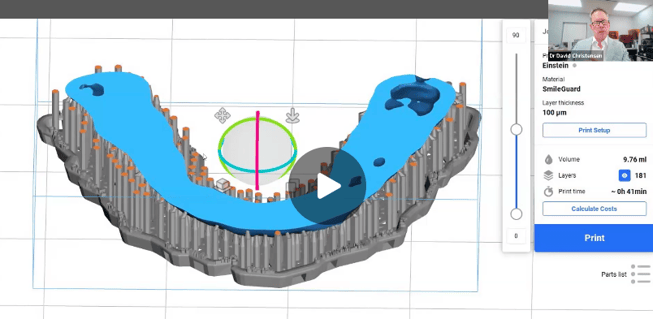
One major takeaway from the webinar was the importance of print orientation and support placement. Dr. Christensen explained that the majority of printing inaccuracies occur along the Z-axis, making print positioning critical for predictable results.
Choosing the Right Printer and Materials
Throughout the presentation, Dr. Christensen reviewed several popular printing ecosystems and shared insights based on his personal experience using many of them in practice. He discussed systems from companies including Formlabs, SprintRay, and Dentfab, highlighting differences in workflow, resin ecosystems, and speed.
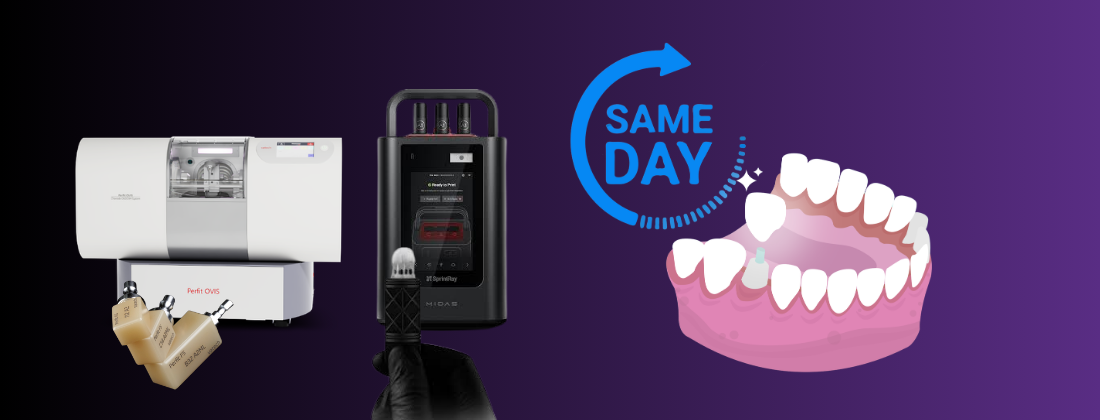
One printer that received significant attention was the SprintRay Midas. Dr. Christensen praised its speed and ability to print ceramic-filled restorations in as little as 7–9 minutes.
He also discussed the evolving material science behind printed restorations, noting that many modern dental resins now contain high ceramic filler percentages for improved durability and esthetics. Importantly, he referenced the ADA’s updated classification recognizing certain printed restorations as permanent restorations, allowing clinicians to appropriately bill insurance carriers.
Everyday Clinical Applications of 3D Printing
A major theme throughout the webinar was that 3D printing is no longer reserved for large laboratories or advanced specialty practices. Dr. Christensen demonstrated how printing can simplify and accelerate many everyday procedures.
Printed Models and Emergency Appliances
One of the simplest workflows discussed involved printing models directly from intraoral scans. In one case, a patient with a fractured tooth needed an immediate temporary solution before traveling. Dr. Christensen designed and printed a monolithic flipper in approximately 45 minutes, providing a fast and highly practical solution.
Occlusal Guards and Deprogrammers
Dr. Christensen also shared his workflow for digitally designing occlusal guards and deprogrammers in exocad. Using digital articulation tools, he can evaluate protrusive and lateral movements before printing appliances that fit predictably and require minimal adjustment.
Because the appliances are digitally archived, replacements can easily be reprinted whenever needed.
Guided Composite Bonding Workflows
Another powerful application involved using printed models and matrices to simplify composite bonding procedures. Rather than freehand sculpting, Dr. Christensen digitally waxes up the ideal contours, prints a model, and fabricates matrices that guide composite placement for improved esthetics and efficiency.
This workflow becomes especially valuable for:
- Diastema closure
- Incisal edge repairs
- Multiple anterior composite restorations
- Smile enhancement cases
Same-Day Printed Ceramic Restorations
One of the most exciting sections of the webinar focused on printed ceramic restorations using ceramic-filled resins.
Dr. Christensen demonstrated complete workflows for:
- Veneers
- Inlays
- Onlays
- Single-unit restorations
Using digital design software and the SprintRay Ceramic Crown HT material, he showed how restorations can be designed, printed, post-cured, and bonded during a single appointment.
He emphasized that while printed ceramics may not replace every milled restoration today, they offer a compelling solution for:
- Same-day dentistry
- Interim long-term restorations
- Conservative restorative cases
- Patients needing fast treatment solutions
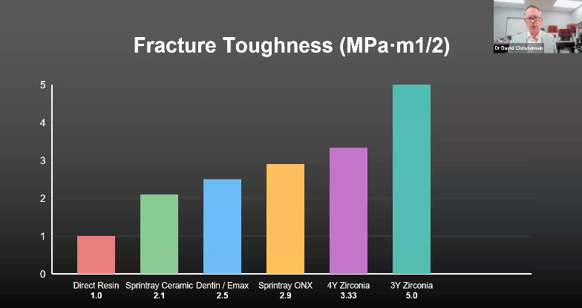
Importantly, he cited emerging research demonstrating promising fracture toughness and durability for printed restorations when used appropriately.
Full-Arch Rehabilitation and Printed Provisionals
Beyond single-unit restorations, Dr. Christensen showcased advanced workflows involving full-mouth rehabilitation and All-on-X treatment.
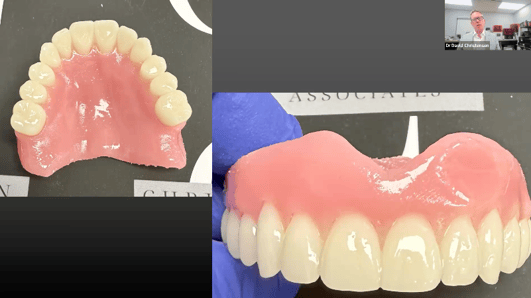
Using printed mockups, prototypes, immediate dentures, and screw-retained provisionals, he demonstrated how digital workflows improve communication, reduce chairside adjustments, and help patients visualize treatment outcomes before committing to major restorative treatment.
One particularly impactful concept was using printed smile mockups during consultations to build patient confidence and improve case acceptance. By printing additive mockups before treatment begins, patients can preview proposed changes and better understand the value of comprehensive care.
Managing Printing Errors and Workflow Challenges
While the webinar focused heavily on the benefits of 3D printing, Dr. Christensen also provided a realistic perspective on troubleshooting and workflow management.
Common causes of print failures included:
- Insufficient supports
- Improper print orientation
- Cold or improperly mixed resin
- Debris contamination
- Incorrect support placement
He stressed that consistency comes from understanding the fundamentals of the printing process rather than simply relying on automation.
The Future of Everyday Dentistry
Throughout the webinar, one message remained clear: 3D printing is no longer experimental technology. It is becoming an everyday clinical tool that can improve speed, flexibility, and patient care across a wide range of procedures.
From emergency provisionals and night guards to smile design mockups and full-arch provisional restorations, Dr. Christensen demonstrated how digital workflows allow clinicians to deliver highly personalized treatment with greater efficiency and control.
For practices considering digital adoption, the webinar served as both an educational foundation and a practical roadmap for integrating 3D printing into everyday dentistry.


-1.png)
